GEO vs SEO
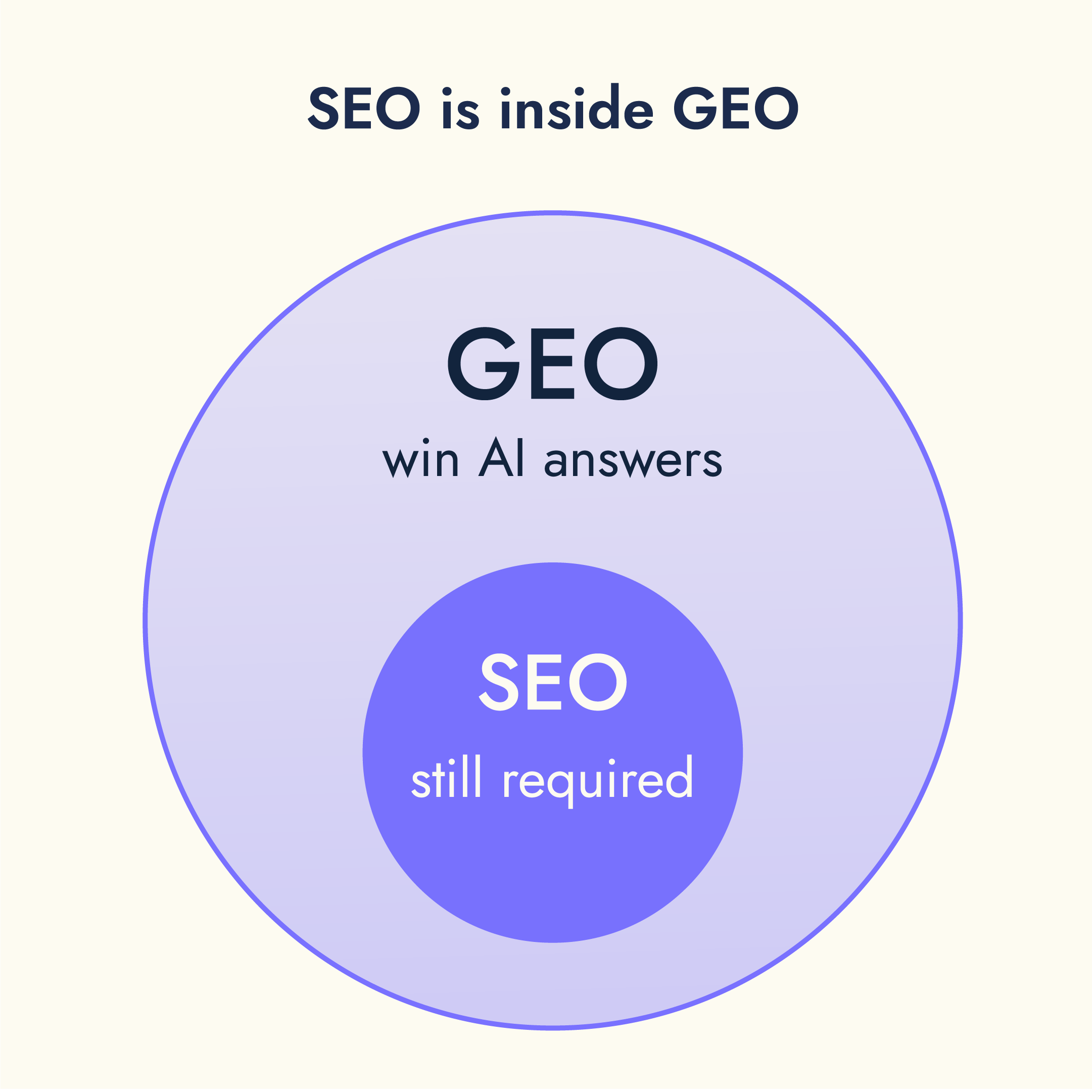
Most marketing leaders are being asked to split their search budget between SEO and GEO. That is the wrong question: SEO now sits inside GEO, and the work you are already paying for is most of the job.

Alex Denning Founder, Ellipsis

Rally Brennan Senior Writer, Ellipsis
You’ve heard that ChatGPT is turning into a real lead source. Your LinkedIn feed is certainly full of people saying so, and at least one of them has already quoted you for GEO on the back of it.
Nobody seems able to tell you how SEO and GEO genuinely differ, what you would do differently day to day, or whether any of your budget has to move.
The only way to answer that is to look at what AI answers actually do. Ellipsis built the first version of FALCON in 2021, on GPT-2, before ChatGPT existed. It now holds more than 25 million B2B prompts, answers and citations, and we read it every week to work out what is changing.
It is also what the client work runs on. Portkey doubled its AI-sourced signups in three months. Codeable became the most-recommended option against Upwork, Toptal and Fiverr in 34 days. Weglot is the most-recommended website translation tool by LLMs.
So this piece answers the question you are actually being asked in board meetings: does your SEO budget need to shift to GEO instead?
Is GEO replacing SEO?
GEO is not replacing SEO -- it is absorbing it, and SEO is now a subset of the work AI search demands. Every technical and editorial job you or your team were already doing still has to be done.
A page that cannot be crawled, read quickly and understood cleanly will not be quoted by an AI system either. What has changed is the scoreboard those jobs are judged against. Doing them well is no longer sufficient on its own.
Page speed is the cleanest example. For SEO, a page loading in around two seconds has been treated as fine for years, and there was little to gain by going below that.
We track citations across Google AI Overviews, ChatGPT and Claude for our B2B clients, and what we see is a curve that never flattens.
A page at half a second is cited around 24% more often than the same page at one second, and it keeps paying the faster you go. Same job, same metric, no ceiling -- and if your technical team stopped at “under two seconds is fine”, they stopped early.
What does GEO actually mean?
GEO means optimizing so that AI systems mention, cite and recommend you in the answers they generate. It has nothing to do with local SEO or geographic targeting, despite the unfortunate collision. That is a different discipline entirely.
It makes sense that people are wondering. According to Google’s own numbers from May 2026, AI Mode has passed a billion monthly active users. Its queries have more than doubled every quarter since launch, and the average AI Mode search is triple the length of a traditional Search query. Before, buyers typed “best paper suppliers”. Now they describe a specific situation in a paragraph and receive a shortlist.
Once that started happening, a lot of SEO agencies quickly changed labels. They had not yet had time to work within the new system or gather evidence. Many are still selling a 2019 SEO retainer with a new cover sheet. That does not make the change any less real. It does make it harder to tell who actually knows anything.
So apply this to the rest of the article too: every claim below comes with the number behind it and where it came from. That is the only way you can check whether we are right. If someone tells you what GEO is without showing you how they know, they are guessing and asking you to guess with them.
What actually changed when AI started answering?
Answers to queries are now built from sentences AI has already retrieved, before anyone even glances at an organic result. This changed search behaviour in three separate ways.
The query stopped being a keyword
A buyer who used to search “invoicing software” now describes their entire business situation -- the team size, accounting stack and compliance regime -- and gets a shortlist built around those constraints.
One keyword’s worth of intent now arrives as dozens of differently worded prompts. That personalization is the whole commercial point. A shortlist assembled around someone’s actual constraints reads like a referral from someone who knows the business, and buyers treat it that way. Codeable’s AI-sourced traffic converts 4.2x better than its Google traffic. Another Ellipsis client, on deals over $100,000, sees AI-sourced opportunities close in about 17 days against a 45-day average.
That is why the leads feel different when they arrive. Nobody turns up asking what you do. They turn up having already worked out why you fit, what the trade-offs are and which competitors they have ruled out.
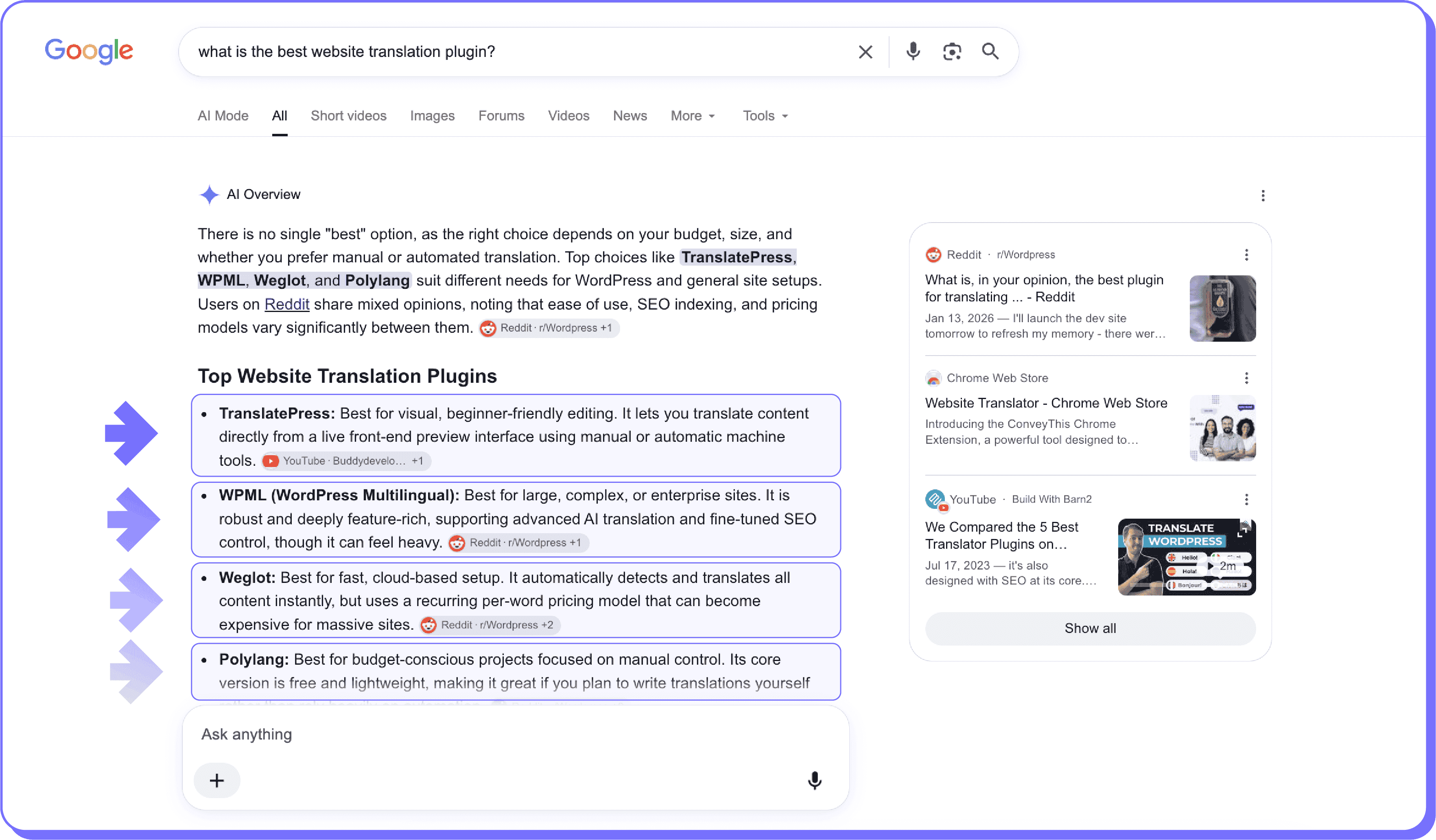
The answer is consumed where it appears
The reader gets what they need without visiting anyone’s site. The article now has a different job: getting you recommended inside the answer. An article that does that and never gets read has still worked. The buyer arrives at your pricing page already knowing why they want you and comfortable with the trade-offs. That is a better conversation than a pageview was ever going to start.
The reward is a quotable sentence, not a relevant page
A page earns its citation one sentence at a time, which is why the sentence now matters more than the page it sits on. Google publishes the exact sentence it lifted from every page it cites. You can read, word for word, what your content contributed -- usually around twenty words, standing alone, stripped of everything that surrounded them.
It also explains why a lot of perfectly good content is invisible. A claim that only makes sense in the paragraph around it cannot be lifted out of that paragraph, so nothing gets quoted.
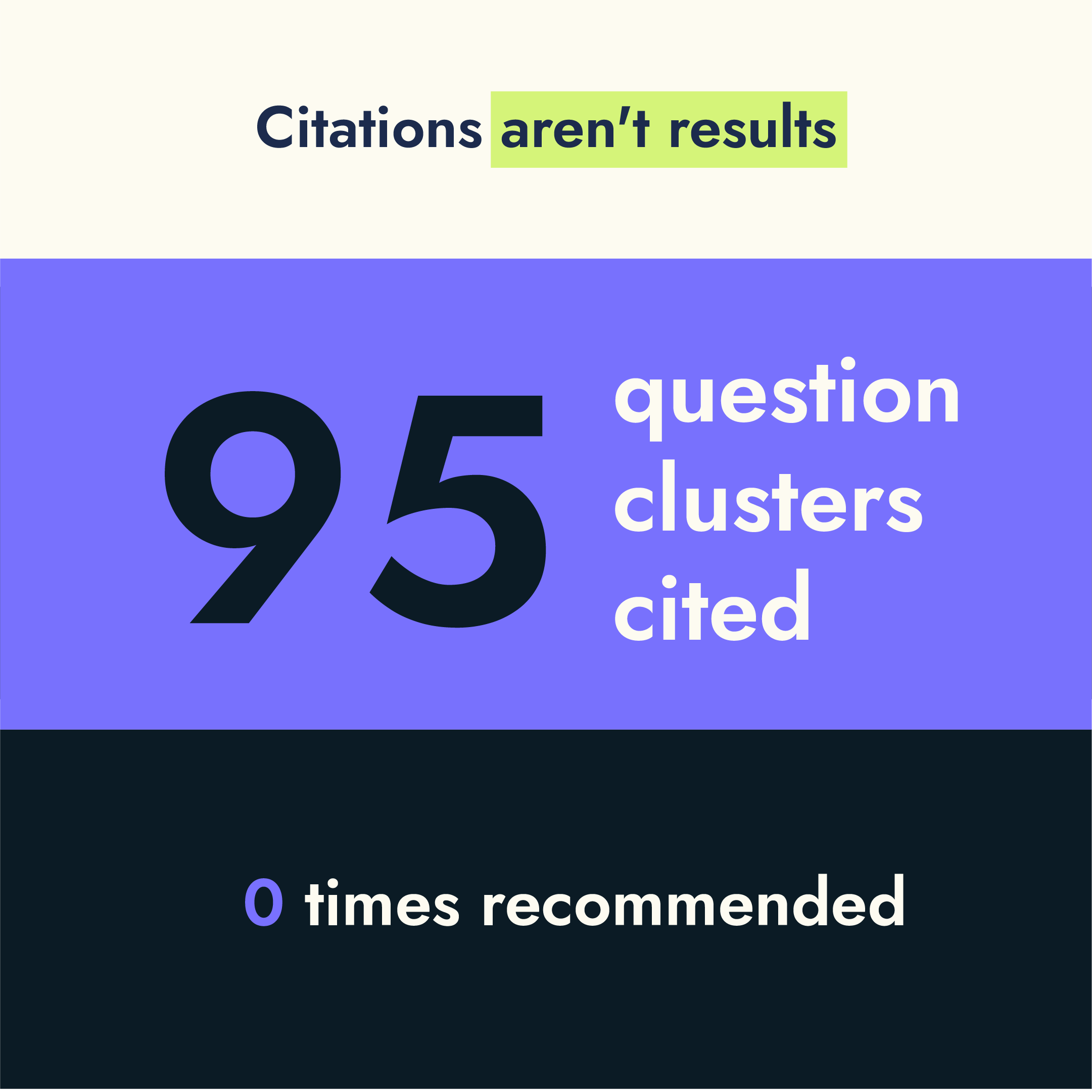
Those outcomes come apart more often than you would expect. We have tracked a brand cited across 95 separate question clusters and picked in none of them. Google tends to quote its sources; ChatGPT rewrites them. Neither is the same as being named as the answer.
The world of ten blue links is going away. Stop funding SEO as a standalone line item and fund this instead -- SEO gets done as part of it. Same jobs, different scoreboard:
| What changes | SEO | GEO |
|---|---|---|
| Goal | Rank the page | Be the source the answer is built from |
| Input focus | A keyword, phrased consistently | A described situation, phrased differently every time |
| Success metric | Positions, clicks and sessions | Citations, mentions and recommendations |
| Content focus | The page as a whole | The individual sentence, and where it sits |
How much of GEO is just SEO?
Most of GEO is standard SEO: technical health, page structure, credibility signals and genuinely useful content. Those carry over more or less untouched.
- Technical health: pages that load fast, render without JavaScript and do not hide the article body from a crawler. It is the same checklist as before, with the speed target moved. Faster keeps paying well past the point SEO stopped caring.
- Page structure: sensible headings, clean HTML and one idea per section. AI systems pull sentences out of sections, so the structure built for skim-readers happens to be the structure they need too.
- Bylines, dates and credibility signals: a named author, a maintained publish date and clean structured data.
- Useful content: if a page does not answer the question a human asked, it will not get quoted answering it either.
AEO, GEO, AI Search and LLM SEO all describe the same work under different labels. There is no meaningful difference in what you would actually do on Monday morning. Pick whichever one your board understands and move on.
SEO is not dead -- it is a subcategory of GEO now, and the biggest difference is what happens when you do the work badly. Under SEO, a weak page simply did not rank. You were invisible, which is annoying but neutral. Now a weak page can actively hand the recommendation to a competitor.
35.5%
of the 43,220 cases where a brand’s own comparison page was cited leaked the recommendation to a rival.
Those are pages the client paid for, ranking perfectly well, arguing the other side’s case. You are not buying a new set of activities. You are buying the judgment required to construct them, because the cost of getting it wrong stopped being zero.
What does real GEO measurement look like?
If a vendor cannot show you how often AI systems mention, cite and recommend your brand, they are guessing.
Rankings cannot answer it. You can hold a top-three position and never appear in the answer above it. You can also be recommended first by ChatGPT for a question you have never ranked for. Neither shows up in Search Console, because Google does not report AI Overview citations and ChatGPT does not report anything.
Many people see mentions, citations and recommendations as three separate things to track. They are actually stacked on top of each other:
- Mentions: how often AI names your brand in an answer at all. This is the pipeline -- everything else is downstream of being in the conversation.
- Citations: how often AI quotes your pages as the evidence behind an answer. Useful as a lever and an early warning, not as a result.
- Recommendations: how often the answer actually endorses you, and how often you are its first choice. This behaves like a referral and is worth reporting to a board.
That order matters, because citations on their own are a vanity metric. We have had a client sitting on the large majority of citations in its market and seeing almost none of it in the pipeline. That is a perfectly possible place to end up if nobody checks the top of the ladder.
The platform mix also moves underneath you. According to one client’s attribution data, ChatGPT went from 43% of its AI-sourced leads to 4% in six months, while Claude went from 3% to 43%. Track the wrong platform, and you will conclude the work is not landing.
Off-the-shelf tools will give you a version of this. We run our own because the questions that matter are specific to your market, rather than a tool’s default list. Ellipsis has measured how often AI systems mention, cite and recommend brands since 2021. It started on GPT-2, before ChatGPT existed, and now runs around 100,000 prompts a week.
Where should your search budget go?
Keep search as one budget and repoint it: the same spend, judged on whether AI answers recommend you rather than where you rank. Splitting it means paying twice for one job. Usually, that means paying the second time for work the first agency should already be doing.
What your current spend already buys is a site AI can find and read. The pages exist, they load quickly, nothing important is hidden behind JavaScript, and they cover the topics your buyers care about. None of that stops mattering. Pulling money out of it to fund a separate GEO line item would be silly.
What should be included in a GEO budget?
Measurement comes first, because right now you almost certainly do not know how often AI recommends you. You would not sign off paid search spend without knowing your cost per lead. Without a baseline of how often you are named and recommended today, every decision below this line is a guess.
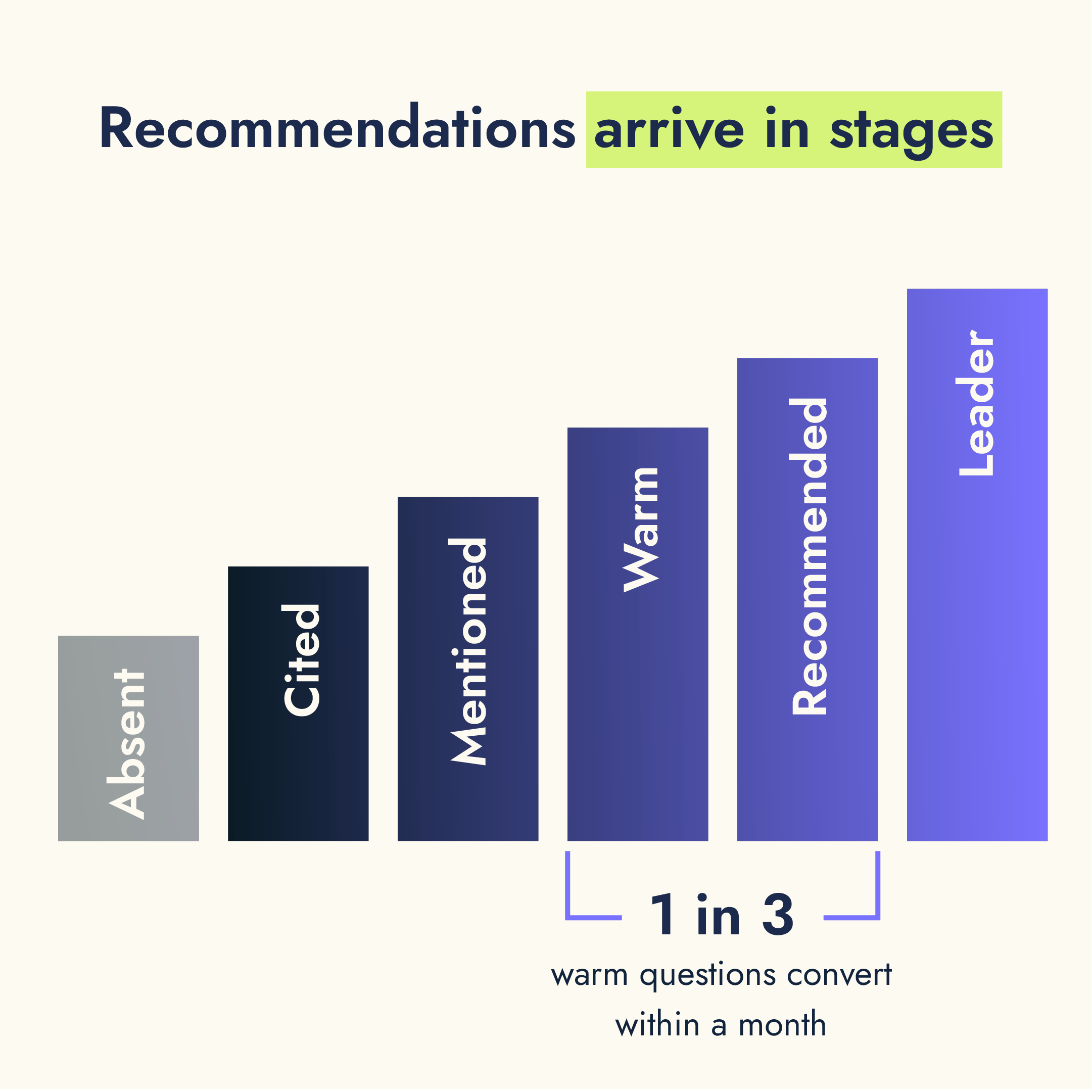
Then fund the pages that move you up the ladder. Recommendations arrive in stages, and every buying question in your category sits on one now: absent, cited, mentioned, warm, recommended or leader.
Ellipsis Research tracks this weekly. Across 2,740 warm questions and 14,112 cold ones, a warm question converts to a first recommendation within a month one time in three, against one in eight. New money buys the work that moves a question up a stage: getting into the sources AI pulls from, writing the sentence it quotes and pairing it with the page that converts.
There are two outcomes on the table, and most companies get the smaller one without ever choosing it.
- The smaller outcome: some leads move from the SEO bucket to the GEO bucket and your reporting gets more complicated. This happens on its own, and it is most of what the industry is selling.
- The bigger outcome: you get recommended consistently across the questions your buyers actually ask, and lead growth stops being a reallocation of what you already had.
The exception: if your category still runs on legacy search results and buyers are not using AI answers much, your existing SEO work is doing more of the job than this article implies. Local services are the clearest case, where the map pack still decides most of it. It is worth checking either way, because plenty of categories are further along than the people working in them assume.
Before you move any money, put three questions to whoever wants it, us included:
- Which of our buyers’ questions will you track?
- How often are we named, quoted and recommended in those answers today?
- Which pages will you build or change to move us up those stages?
If the answers come back as citation counts and a monthly PDF, that is the 2019 retainer again.