The G2 page you’re optimising isn’t the one AI reads.
Most B2B marketers optimise their main G2 listing to influence AI -- but our data shows it only accounts for 3% of citations. The pages AI actually reads? Compare pages and pros-and-cons fragments. Here's what to do about it.
Most B2B marketers chase reviews on G2’s main listing and refresh their product page to shape what AI says about them. AI is reading something else entirely – and the page that matters is the one your team probably hasn’t looked at.
Two things about G2 have become common knowledge in B2B marketing.
The first is that G2 matters more than it used to. It’s easy to notice that buyers cross-check vendors against G2 before any serious sales conversation, and AI cites G2 heavily when answering “best X” prompts and “X vs Y” comparison queries.
Besides that, a lot of marketing experts have sat through G2’s spring webinar on the AI-search angle and came away with the same conclusion: Refresh the product description, get more reviews on the main listing, and claim a few more categories.
The second is that the way to influence what AI says about you on G2 is to optimise the G2 product page itself. That’s what the platform’s own marketing recommends. That’s what the playbook says.
However, in our own experience and through testing, we realised that the data says the playbook is mostly wrong, in a specific and useful way. Here’s what AI is actually reading on G2, and what to do about it.
The proof
We track AI citations monthly across Google AIO, OpenAI, and Anthropic for around fifteen B2B SaaS clients. For one client in a competitive infrastructure category, we pulled six months of G2 citation data and broke it down by URL type.
The main G2 product page – the canonical listing that marketing teams treat as the optimisation target – was cited eleven times across the six-month window.
Yep, eleven. In comparison:
- The pros-and-cons variant of the same review page was cited 127 times.
- The compare page versus the client’s largest competitor was cited 113 times.
- The compare page versus their second-largest competitor was cited 96 times.
- The pricing page was cited 37 times.
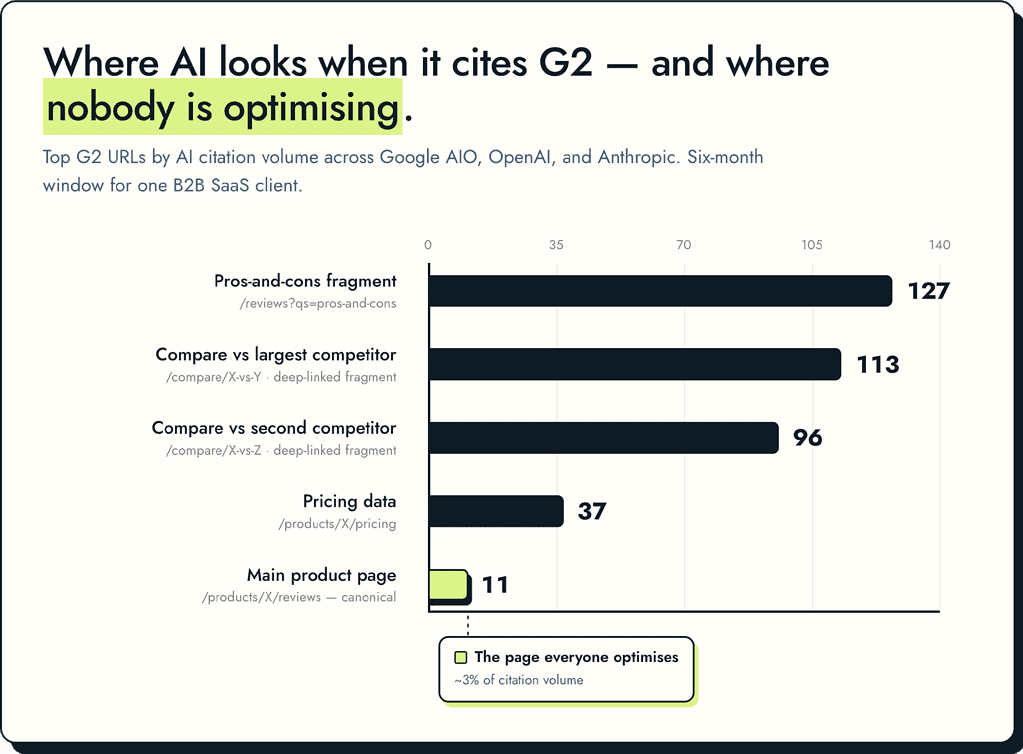
So the main product page got about 3% of the total G2 citation volume for this client. This is nothing compared to the 54% for compare pages and even the 33% pros-and-cons fragments got.
It turns out, the thing most marketing teams treat as the canonical G2 surface – the one their G2 customer success rep talks about – is the smallest single share of the citation pool.
| URL type | AI citations | Share of top 5 |
|---|---|---|
| Pros-and-cons fragment (/reviews?qs=pros-and-cons) | 127 | 33.1% |
| Compare vs largest competitor (/compare/X-vs-Y) | 113 | 29.4% |
| Compare vs second competitor (/compare/X-vs-Y) | 96 | 25.0% |
| Pricing data (/products/X/pricing) | 37 | 9.6% |
| Main product page (/products/X/reviews — canonical) | 11 | 2.9% |
The pattern holds across other clients we checked. The bare /reviews URL is a single-digit share for every B2B SaaS brand we have G2 data on. The bulk of the work is done by the compare-page templates and the pros-and-cons fragments – and within those, AI is mostly pulling deep-linked #:~:text= extracts from auto-generated summary blocks that G2 layers on top of the underlying reviews.
The thing that’s actually getting cited is G2’s commentary about the product. Not the product’s commentary about itself.
So, what is AI actually reading?
First, you have to understand what’s happening on those pages.
G2’s pros-and-cons block, the compare-page summary, and the alternatives-page recommendation rows are all algorithmically generated. G2 runs an internal model that reads the underlying reviews and emits a structured summary:
- Top pros (with mention counts visible next to each phrase);
- Top cons (with mention counts);
- Comparison statements built off the review delta between two products;
- One-paragraph AI-written summaries at the top of each compare and pros-and-cons page.
These auto-generated blocks are what AI cites. The cite pattern is specific – fragment-anchor URLs that target the exact sentence inside the block, not the page as a whole. AI doesn’t reach for “the G2 reviews page for X.” It reaches for the specific extracted sentence within G2’s summary.
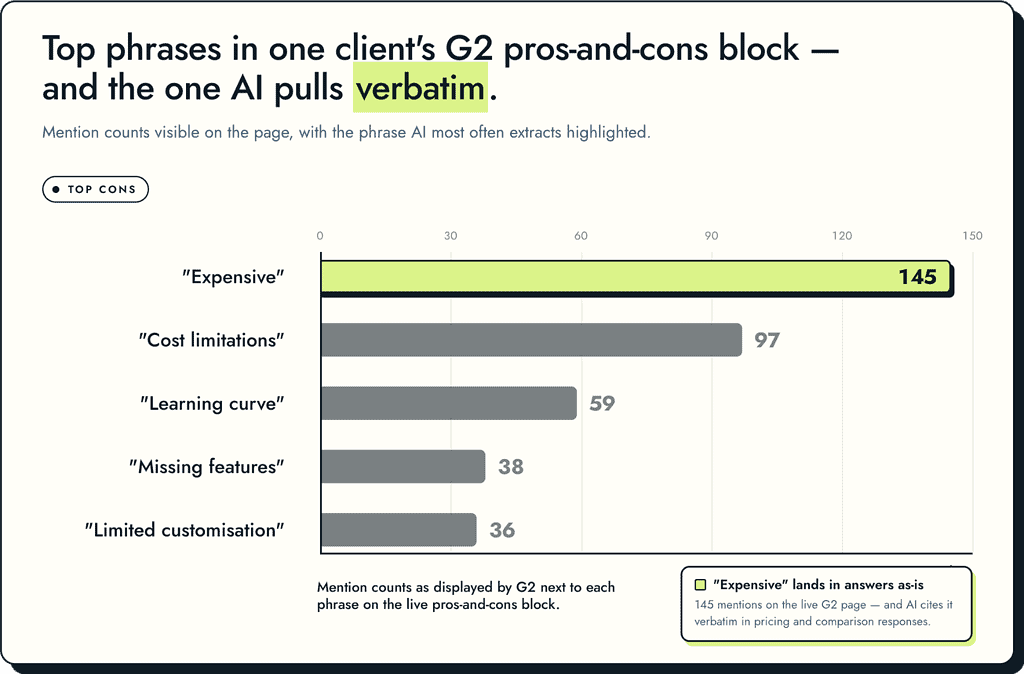
On the same client we pulled the citation breakdown for, the dominant negative phrase in their pros-and-cons block was “expensive” with 145 mentions, followed by “cost limitations” at 97. Two specific words, with mention counts visible on G2’s own page, drove the majority of negative AI framing about pricing. AI was pulling them verbatim into responses about the client and reshaping them into stronger commercial claims downstream.
Chart: Top phrases in one client’s G2 pros-and-cons block
Top cons
| Phrase | Mentions | AI extraction |
|---|---|---|
| “Expensive” | 145 | Verbatim, multiple responses |
| “Cost limitations” | 97 | Paraphrased in compare summaries |
| “Learning curve” | 59 | Occasional |
| “Missing features” | 38 | Occasional |
| “Limited customisation” | 36 | Rare |
The product description, the seller-controlled “About” section, the screenshots, the category tags – the things G2’s own product team will tell you to optimise – are what AI ignores almost entirely. They’re inputs to the underlying review process, indirectly, but they aren’t the surface AI reads when answering questions about you.
What changes the auto-generated blocks is the underlying review corpus – how many reviews exist, what star ratings they cluster around, and which specific words keep showing up across hundreds of individual comments. G2’s summary model reads that corpus and emits the phrases AI then quotes.
In simple words, change what reviewers write, and you change what AI says.
Why the seller-controlled page barely matters
G2’s spring webinar told B2B marketing teams two things: keep your reviews fresh (correct), and keep your product listing fresh (less correct than implied).
The reviewer-freshness instinct is right, but for a different reason than the platform’s own marketing suggested. New reviews feed new phrases into G2’s auto-summary block – and that block is what AI quotes verbatim. Fresher reviews mean fresher summary language, which means different sentences for AI to extract. That’s the actual mechanism behind “keep your reviews fresh.”
The listing-freshness instinct is mostly self-serving on G2’s part. Refreshing your product description drives engagement on G2’s platform, which is good for G2 – but it does almost nothing for AI’s articulation of your brand. AI isn’t reading your listing. It’s reading the auto-generated commentary page next door.
So the lever isn’t the seller-controlled page. It’s the review corpus that feeds G2’s auto-summary. Once you accept that, the playbook changes shape.
What to do about it
If you want to influence what AI says about you on G2, the playbook has four parts.
1. Audit which G2 URLs AI is actually citing
If you’re tracking AI citations (if you aren’t, this is the first thing to set up) pull every G2 URL that appears in your citation set over the last six months. Group them by type: main /reviews page, pros-and-cons fragment, compare-vs pages, alternatives pages, pricing data, listicles on learn.g2.com.
Changes are, you’ll find the same shape this client did. The main page is usually a sliver; the commentary surfaces are the bulk.
2. Read the auto-generated blocks on your top-cited URLs
The exact sentences AI is pulling are usually visible on the page. For example, the pros-and-cons block lists each phrase next to its mention count and the compare-page summary has its AI-written paragraph at the top, with specific bullet rows about your product underneath.
Look for the negative phrases doing the damage – the ones with the highest mention counts on cons, and the ones showing up verbatim in AI responses you’ve already collected.
3. Run a reviewer talking-points program
Smart B2B marketing teams already solicit reviews from happy customers. The shift is to give those customers specific dimensions to address – the words you most need them to write about.
If “expensive” is your top con with 145 mentions, ask reviewers to write about value-for-money or specific feature density that justifies the cost. The auto-summary downstream of those reviews rebalances within a few weeks.
And don’t worry, you’re not gaming the system. You already have genuinely happy reviewers; you just want to guide them toward the parts of their experience that most need surfacing.
4. Build on-site counter-content
If AI is citing “expensive at higher usage levels” about your product, build a cost-transparency page with worked examples at different usage tiers. Concrete numbers, real comparisons, all-in pricing. A page with a real cost matrix will always outperform a page that claims “competitive pricing” with no evidence – and the matrix gets cited as the counterweight to the negative G2 phrase.
The seller-controlled product description on G2 is still worth a single pass to remove obvious own-goals — if your description leads with “no-code” or “SMB-friendly” in a category where you want to be seen as enterprise, change that. But treat it as a fifteen-minute hygiene task, not the main event.
It’s not the page you’ve been pushing
G2’s own product team will tell you to optimise the product page, but the data says AI doesn’t read the product page. AI reads what G2 says about you on its own commentary surfaces – the pros-and-cons block, the compare-page summary, the alternatives-page recommendation rows. Those surfaces are downstream of your reviews, not your product description.
The page everyone optimises is the wrong page. The page that matters is the one G2 generates about you, automatically, from a corpus you can shape.