AI isn’t a black box. Here’s how to steer what it says about your brand
Most B2B marketers think AI is a black box they can't influence. Our data proves otherwise -- one positioning campaign shifted how AI describes a competitor by 5x, and the effect held for six months.
Most B2B marketers believe they can’t influence AI’s articulation of their category. The data says otherwise – and the mechanism is well understood and measurable.
Most B2B marketers I talk to believe two things about AI search.
The first is that buyer decisions happen exclusively in AI platforms. The proof is in the proverbial pudding: Organic traffic flattens, competitors get cited inside ChatGPT and Perplexity, and the buyer’s research funnel collapses from a dozen touchpoints into a single conversation with a model. They’ve accepted this.
The second is that AI is a black box. They can’t influence what ChatGPT says about their product or what Google’s AI Overview cites as the source of truth. The model decides, and they can only sit and watch helplessly.
Well, my experience and testing have proved that the second belief is entirely wrong. Here’s why, and what you can do about it.
The proof
Late last year, a B2B SaaS client of ours launched a positioning campaign targeting a specific competitor. The main point they wanted to make was that this competitor was rigid and hard to escape from, whereas our client’s offering was the opposite: no lock-ins for customers. The campaign ran for a quarter with the standard set of category-leadership work – comparison pages, product education, integration content, etc.
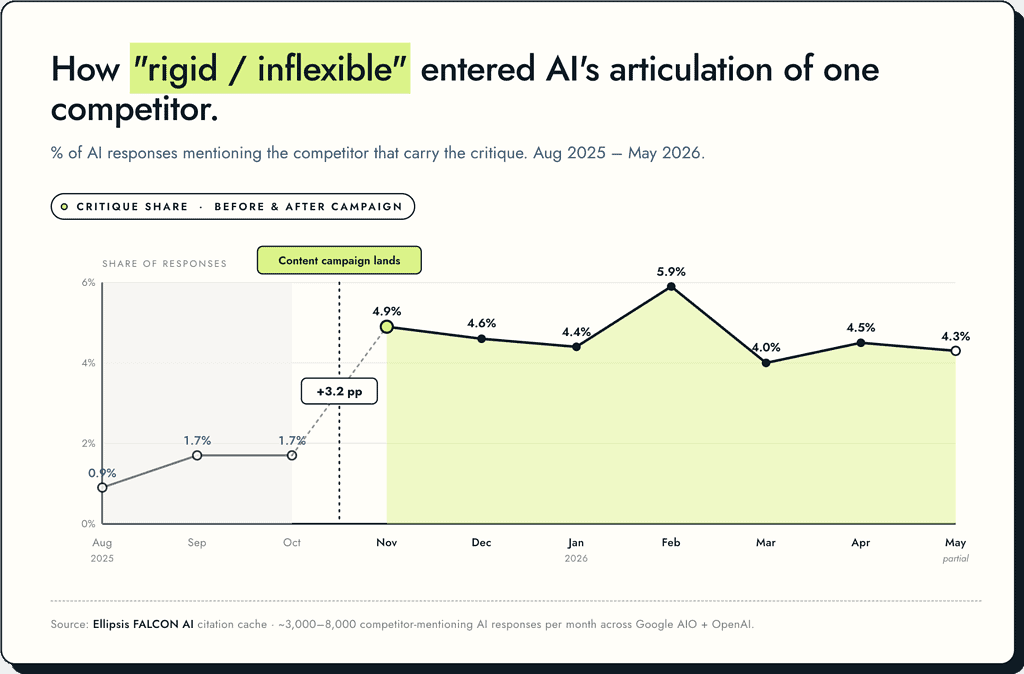
We tracked how AI describes that competitor across thousands of AI responses, monthly, going back to August 2025. Specifically, for responses that mention the competitor, how often does AI describe them as “rigid” or “inflexible”?
- In August, 0.9%. About one in a hundred responses.
- By November, 4-5%. About one in twenty.
That rate has held steady ever since. Five times the previous baseline, sustained for six months and counting.
Chart 1: How “rigid / inflexible” appears in AI’s articulation of one competitor
| Month | Competitor mentions (n) | “Rigid / inflexible” (%) |
|---|---|---|
| Aug 2025 | 1,016 | 0.9 |
| Sep 2025 | 2,091 | 1.7 |
| Oct 2025 | 3,715 | 1.7 |
| Nov 2025 | 775 | 4.9 |
| Dec 2025 | 1,182 | 4.6 |
| Jan 2026 | 822 | 4.4 |
| Feb 2026 | 984 | 5.9 |
| Mar 2026 | 1,398 | 4.0 |
| Apr 2026 | 1,400 | 4.5 |
| May 2026 (partial) | 699 | 4.3 |
Through its content and special positioning, the campaign changed how AI talks about a competitor.
And here’s another example from a different angle. Across the same period, three coined terms that our client invented to describe their platform’s architecture and workflow went from appearing occasionally in AI responses to being category vocabulary. When AI uses any of those three terms in a response now, it ties them to our client 85-99% of the time.
As you can see, that’s as far from a black box as it can be: That’s a system you can feed.
The mechanism
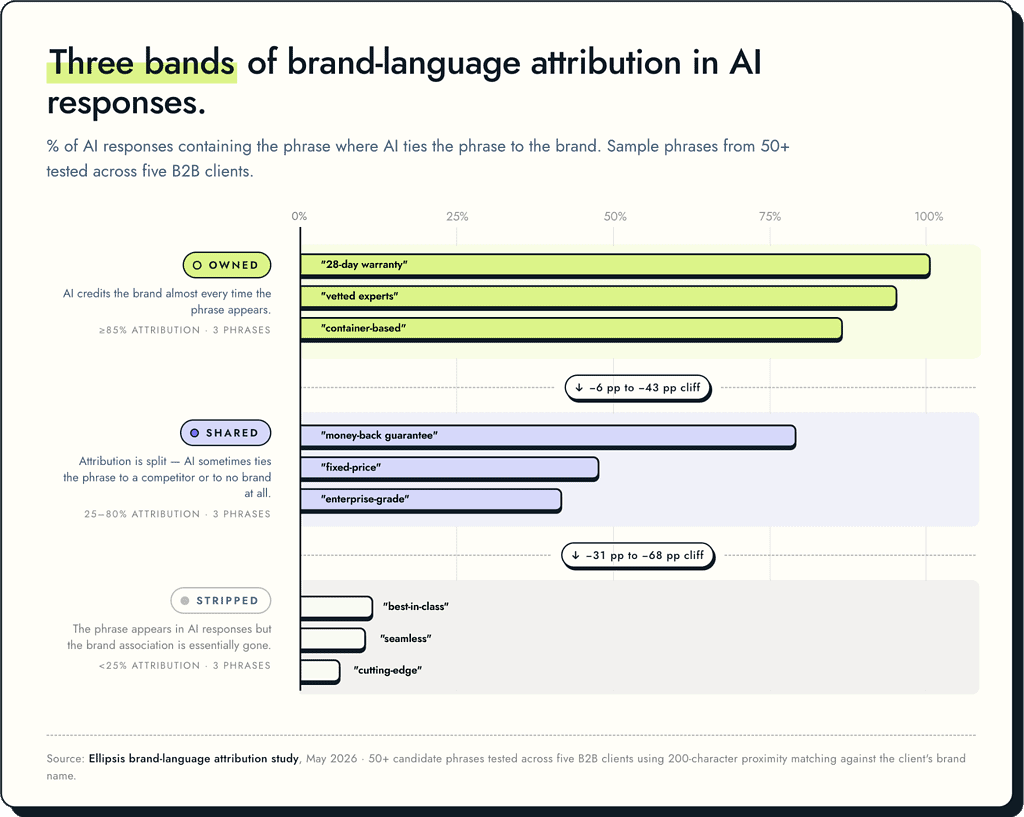
To make this useful – not just a couple of impressive numbers – we have to understand why some brand language survives into AI’s outputs verbatim, and other brand language gets stripped or paraphrased away. We analysed 50+ brand phrases across five different B2B clients and found three sharp bands.
Chart 2: Three bands of brand-language attribution in AI responses
OWNED (≥85% attribution)
| Phrase | Brand attribution % |
|---|---|
| “28-day warranty” | 100 |
| “vetted experts” | 98 |
| “container-based” | 85 |
These are claims AI quotes verbatim, with your brand attached. 85-100% of the time the phrase appears, AI ties it to you.
This is because owned claims are concrete and falsifiable – anyone can go on your website and check them immediately. This usually includes things like “28-day warranty,” “Top 2% vetted,” or “Container-based architecture.”
They’re distinctive enough that no competitor credibly makes the same claim. If three vendors all say “enterprise-grade,” nobody owns it. If only one says “Dev/Test/Live” and means a specific workflow, that one owns it. And they tend to fill a category gap: Customers didn’t have a word for the thing, you supplied one, and the category adopted it.
SHARED (25-80% attribution)
| Phrase | Brand attribution % |
|---|---|
| “money-back guarantee” | 79 |
| “fixed-price” | 48 |
| “enterprise-grade” | 42 |
Next, we have claims AI uses but doesn’t credit you for them – 25-80% attribution. These are concrete claims, often structurally clean, but since everyone uses the same language, you can’t be named as their owner.
Examples include “enterprise-grade” hosting, “fixed-price” freelance work, and “real-time” data – all things businesses tend to slap on indiscriminately. AI mentions the phrase but credits it to the category, not to you specifically. The structural quality of the claim is fine; the brand attribution doesn’t follow because the language is the category default.
STRIPPED (<25% attribution)
| Phrase | Brand attribution % |
|---|---|
| “best-in-class” | 11 |
| “seamless” | 10 |
| “cutting-edge” | 6 |
Finally, we have claims that look like brand language but completely disappear in AI’s responses – under 25% attribution.
These come in two flavours:
- Opinion puffery – “best-in-class,” “cutting-edge,” “seamless,” “transformative“. Since these are vague and technically don’t mean anything anymore, AI generates its own evaluation vocabulary when it decides a vendor is good, without quoting your words.
- Generic category language – “enrichment API,” “firmographic data,” “B2B platform” – which AI uses freely to describe everyone in your category, leaving your brand without credit.
Now, here’s how you test your copywriting and brand claims before you write it on a page: Would a competitor credibly make the same claim?
- If no, and the claim is concrete, you have an owned candidate. AI will quote it verbatim, tied to you.
- If yes, you’re sharing the language with competitors, and AI will split the attribution.
- If the claim is evaluative – “leading,” “best,” “transformative” – strip it and replace it with something measurable. AI doesn’t repeat your opinions about yourself. It generates its own.
Why content shifts how AI describes a competitor
The second finding – a content campaign that moved AI’s description of a competitor from 0.9% to 4-5% – works on the same system, from a different angle.
AI’s outputs are fed by the open web. When only a handful of voices call a competitor “rigid,” AI treats it as an outlier opinion. When a category leader publishes a quarter’s worth of substantive content, making the same case – comparisons, evidence, mechanism – that description stops being an outlier and becomes the default. AI starts repeating it as though it’s just how the category works.
This is how knowledge production has always worked; AI just systematises and accelerates it. What used to take years of analyst reports and journalist coverage now takes a few months of well-targeted content.
Now, three things have to be true for the shift to happen:
- The articulation has to be specific and structurally clean. “Rigid” works because it’s a one-word, falsifiable, concrete claim. “Less flexible than its peers” doesn’t.
- The content has to exist at sufficient depth and across enough surfaces. Not one page but a cluster of pages making the same point through different angles.
- The articulation has to fill a gap in the category’s existing vocabulary. If buyers already have a word for what you’re describing, AI will use the existing word instead of yours.
Get those three right, and AI’s articulation of your competitive position moves.
What to do about it
If you want AI to start saying specific things about you and your category, the playbook has three parts.
1. Audit your existing brand language against the three bands
Take your main pages (homepage, product pages, pricing page, about us, etc) and list every adjective and brand claim. For each one, ask: could a competitor credibly say this? If yes, AI isn’t going to credit you for it. Replace it with something concrete and distinctive.
❌ The line “we deliver world-class enterprise software solutions for ambitious teams” survives the test as: nothing. “World-class” is an opinion. “Enterprise” is shared. “Solutions” is generic. “Ambitious teams” is evaluative. AI replaces all of that with its own wording and they are all attributed to itself, not to you.
✅ The line “every project comes with a 28-day warranty, fixed-price quotes, and access to pre-vetted experts you choose from directly” fares better.
- “28-day warranty” is owned – concrete number, specific window, distinctive.
- “Pre-vetted” is owned-with-effort if used consistently across the site.
- “Fixed-price” is shared – most freelance platforms claim it.
Because the sentence is mostly owned-band language, AI quotes it verbatim with the brand attached in roughly 87% of responses where it appears.
2. Pick the competitive message you want AI to repeat, and run it as a campaign
Here’s that cluster of pages we mentioned earlier. Even though the goal is the same, all pieces will have different angles, formats and surfaces.
Examples include:
- Comparison content where buyers go to choose.
- Educational content where they go to learn.
- Product pages.
- Community discussions.
- Guest posts on industry sites.
AI will then pick up sources differently depending on the content type, but the message has to land across enough of them for the shift to stick.
3. Measure with the right signals
Three things to track monthly: how AI describes your competitor, which of your brand phrases show up in AI responses with your name attached, and your share of recommendations on neutral prompts – prompts where nobody names a vendor.
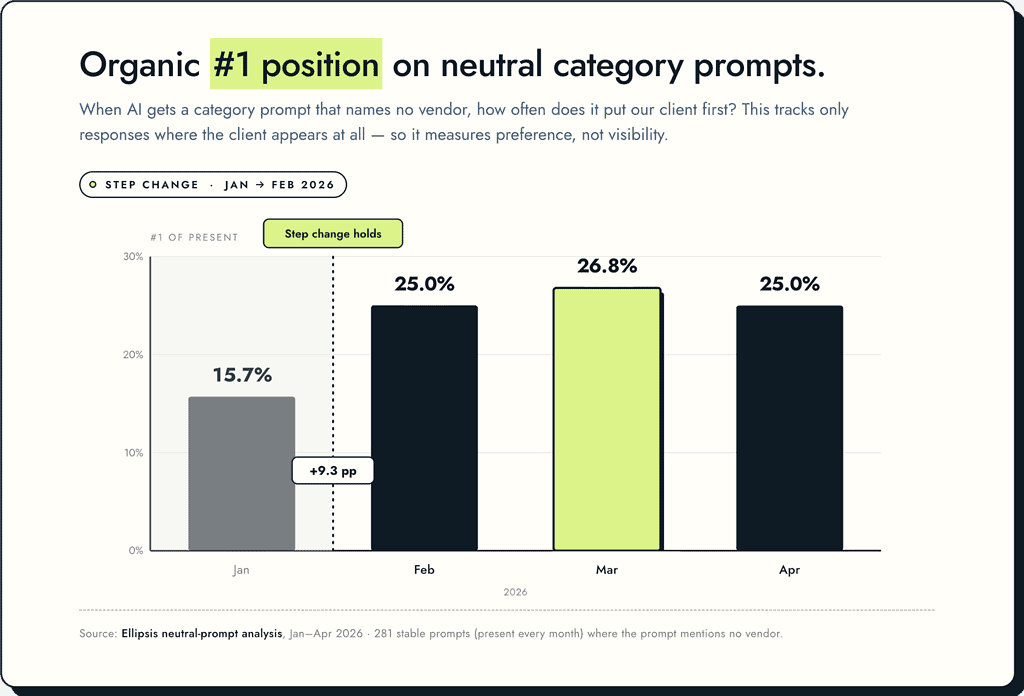
That third signal is the cleanest read on whether AI is genuinely shifting in your direction, because it controls for prompts that name you specifically (which inflates the numbers). The client, whose competitor moved from 0.9% to 4-5% on “rigid”, also moved on this metric. When AI gets a category prompt that names no vendor and mentions our client at all, it now puts them at #1 in one in four times. Four months earlier, that rate was one in six.
Chart 3: Organic #1 position on neutral category prompts
What we wanted to understand here is how often AI puts our client first when it gets a category prompt that names no vendor? This tracks only responses where the client appears at all – so it measures preference, not visibility.
| Month | Client present (n) | At position #1 (n) | #1 of present (%) |
|---|---|---|---|
| Jan 2026 | 51 | 8 | 15.7 |
| Feb 2026 | 36 | 9 | 25.0 |
| Mar 2026 | 41 | 11 | 26.8 |
| Apr 2026 | 36 | 9 | 25.0 |
There’s no black box
AI says what it has read. What it reads is, in significant part, what category leaders and analysts choose to publish. If you don’t publish substantive content articulating your category and your competitive position, AI defaults to whatever the loudest voices in your space have produced — which is often your competitors.
The mechanism works for any B2B brand with a clear point of view and the budget to ship the campaign. The hard part isn’t the technology. It’s having a position worth taking and the discipline to publish through it consistently for a quarter or more.
The B2B marketers winning AI search right now are the ones who decided their position out loud, repeatedly, in well-structured content, across enough surfaces that AI adopted it as the default way the category gets described.
That’s the game.